From Revenue to the money desk
The Revenue desk (CRM) and Books are wired together: deals that cross a pricing line stop for your signature, and a deal that closes won drafts its invoice on the money desk automatically. This guide covers the handoff — for the Revenue desk itself, start at the CRM guides.
Where Revenue holds surface
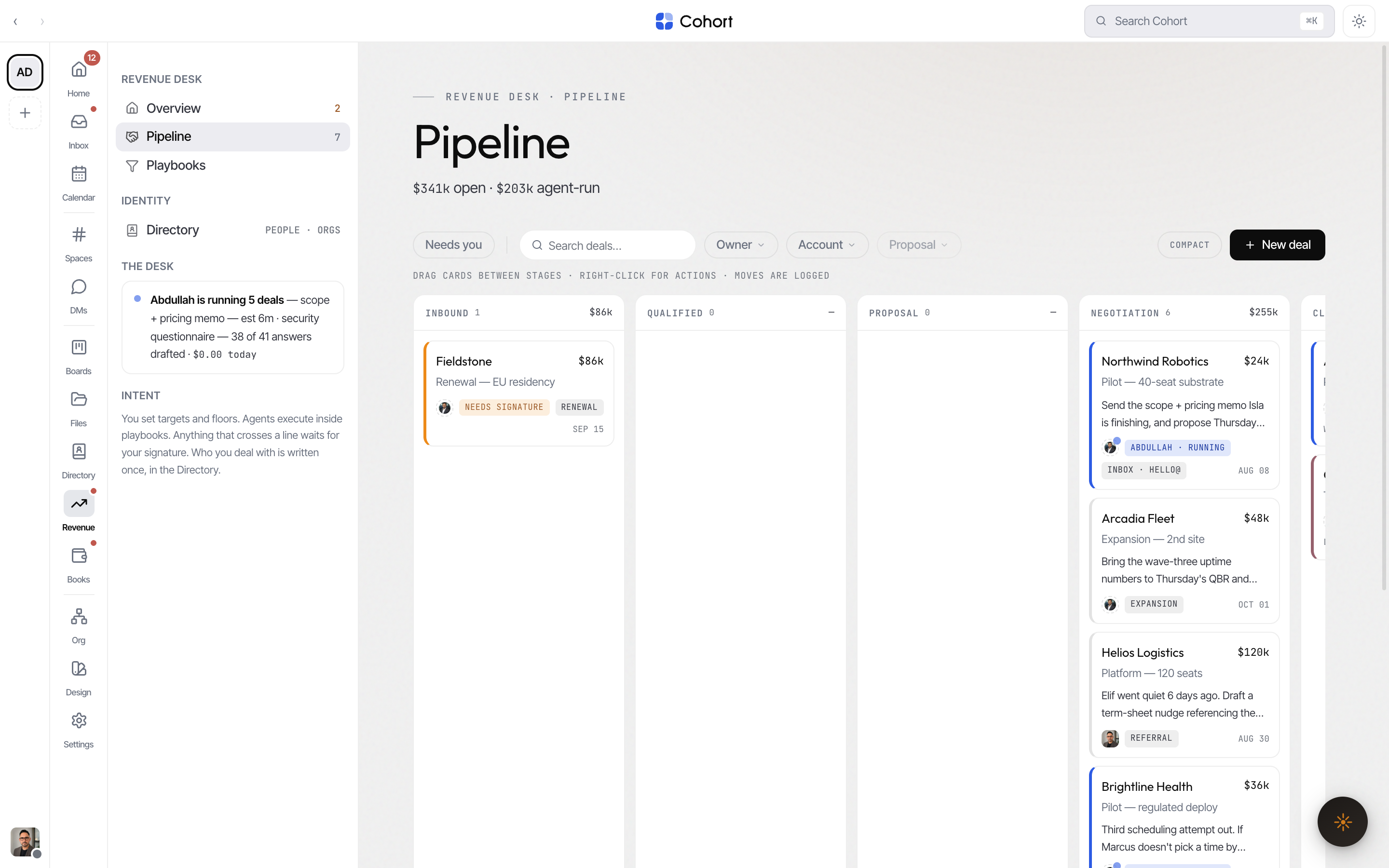
When an agent-run deal step crosses a revenue playbook's line — a discount or term beyond the priced threshold — the deal is held. You see it in three places:
- On the pipeline, the deal card carries a NEEDS SIGNATURE badge.
- On the Revenue desk overview, held deals count into the needs-you number.
- On the deal record, a held card states the reason, the margin impact, and the reversibility of signing.
You can also hold a deal yourself: Hold next step for me on any deal is a manual signature gate — no playbook needed.
Resolve a held deal
A pending hold resolves one of three ways:
- Sign it
Signing releases the held step — the drafted paper countersends. Only a human seat can sign; an agent-lane call is refused by the server no matter how it arrives. The resolution is logged with the margin impact.
- Return it
Returning sends the work back to the running agent for another pass, with your note attached (or honestly recorded as no note).
- Re-price it
Editing the held terms re-prices the deal against the playbook's live line: inside the line, the hold clears and the agent sends tonight; still over, the hold stays with the re-priced margin impact.
Revenue holds behave like every other approval in Cohort — held by a playbook, resolved by a human, logged to the ledger. For the workspace-wide approvals model, see Approvals, holds, and signatures.
What happens on closed-won
Closing a deal as won triggers the Books handoff:
- Books drafts a SalesInvoice for the deal's value — pre-filled with the account as payee, the deal name as description, NET 14 terms.
- The deal trail logs it: "Closed won. INV-#### drafted in Books — review + send from the Money desk."
- The draft is never auto-sent. Sending posts the AR journal and arms the chase ladder — that is a deliberate act of its own, taken from Invoices.
The handoff is skipped honestly when the deal has no value, when an invoice already exists for the deal, or when Books is not provisioned for the org — the close itself always stands.
How the records stay linked
- The Books payee and the CRM account resolve to the same Directory organisation: a payee minted by the closed-won draft gets the deal's account stamped, so future drafts resolve directly.
- From any invoice or bill record, Open counterparty in Directory jumps to that organisation.
- Customers offered in the invoice composer include organisations the CRM knows as customers, prospects or leads — even when their payee record is a supplier (a counterparty that both bills you and is billed by you is one record, not two).
Under a guardian lens
Viewing the Revenue desk or Books as a seat you guard strips approval material on both sides: held-signature cards and badges are absent from CRM, and the Books waiting-on-you queue is empty. Ledger facts stay. Approvals wait on the guardian alone.