Design: the brand foundation
Design is where the workspace's brand lives: one foundation (colour, type, scale, voice, visual language) that every template, deck and agent-produced artifact draws from. Anyone can read it; owners and admins can edit it. Saving versions it — and everything downstream re-renders from the saved version, never from someone's half-finished draft.
The section has six views: Foundations, Logos & marks, Voice & tone, Visual language, Imagery, and Templates (templates have their own guide).
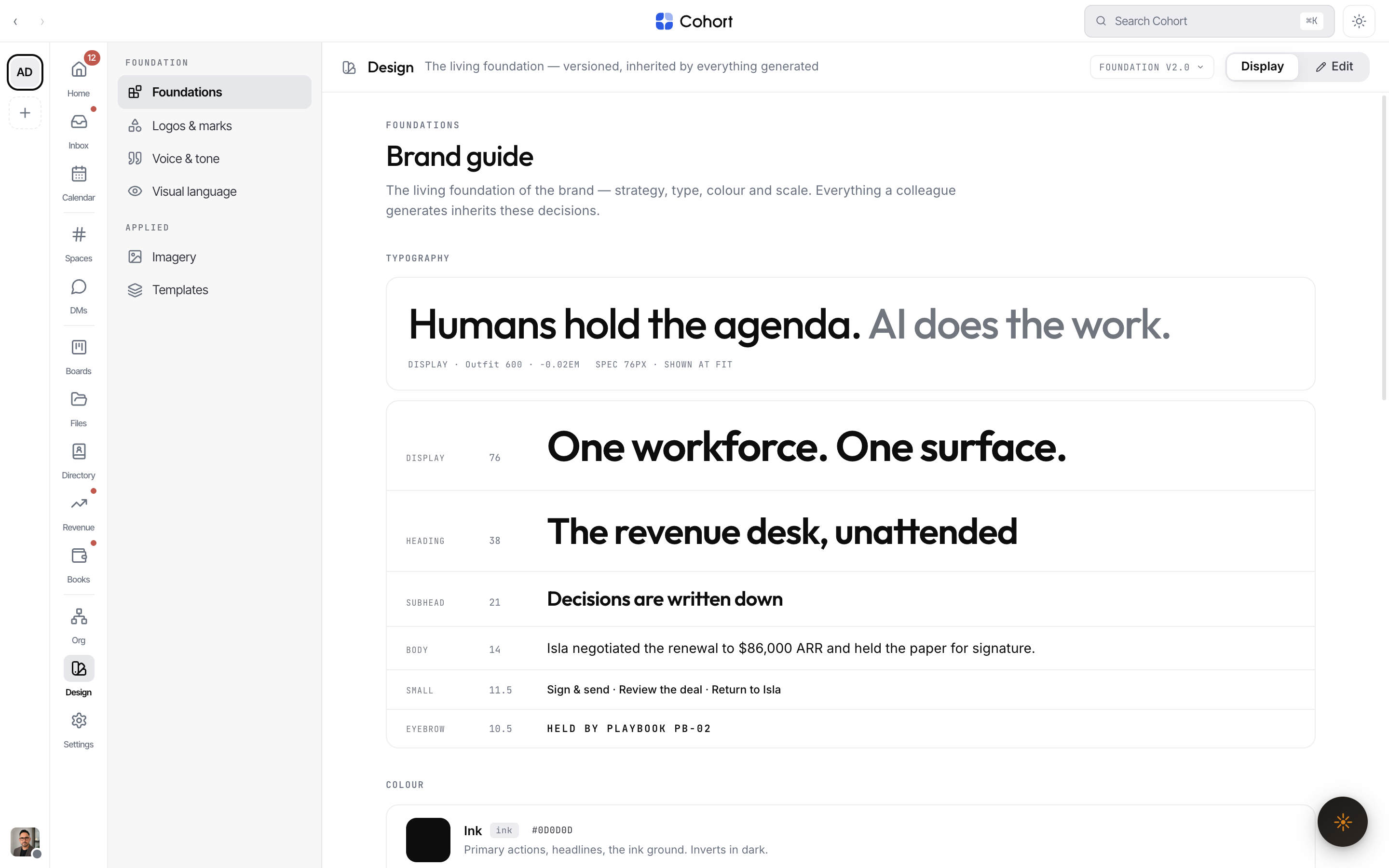
Display and Edit
The section topbar carries a Display ↔ Edit toggle (edit is admin/owner only) and a version chip — V2.n, the saved foundation's sequence.
- In Edit, every change previews live across the whole section — a typeface swap re-renders the specimen, a colour change re-tints the ramps — but nothing is saved until you choose Save foundation, which writes an immutable version with your note.
- The version chip opens the history: every version with its author, source (edit, AI amend, restore, generation …) and note. Restore creates a new version from an old snapshot — history only moves forward, so a restore is itself auditable.
- If a colleague saved while you were editing, a conflict diff shows both sets of changes before anything is overwritten. Your unsaved draft is also recovered per editor, so a closed tab does not lose work.
Foundations
The foundation's core: the brand archetype and principles, typography (display/body/mono faces with a live specimen and a full type hierarchy), colour (the role palette, derived 50–950 ramps, and a live WCAG contrast audit), and scale (spacing, radii, depth) with a PX/REM/EM unit toggle.
Logos and marks
Upload and manage the brand's marks. A workspace with no wordmark yet falls back to a typographic treatment of its own name (the legal entity name when the company profile sets one).
Download the brand kit
Download kit on Logos & marks builds a zip from the saved foundation: tokens.css, tokens.json, a Tailwind theme fragment, the marks, and a voice one-pager. The export is byte-deterministic — the same foundation always produces the same bytes — so a downstream repo can diff it. Any member can export; the ledger records the manifest (paths, sizes, digests), never the file contents.
The kit's colour roles and neutrals come from the same resolver templates
render with, so the primary in your exported tokens.css is by construction
the colour your templates paint with.
Voice and tone
The brand's verbal identity: the voice statement, the trait set, and the say/avoid lexicon. Everything here lives in the foundation, so edits preview live and version with everything else — and the same voice data ships in the kit's one-pager.
Visual language
Motif policies, the icon library, the image treatment, and the image-style prompt that generation uses. Miniatures re-render as you flip a motif chip, unsaved until the foundation is versioned.
Imagery
The canonical image library templates pull from — one image per slot, generated against the foundation and the style prompt. The workspace generates three slots today: HERO (site and deck openers), TEXTURE (section grounds) and OG DEFAULT (the 1200×630 share card); the grid grows as the plan does.
- Each card shows its status: done, stale (the foundation moved since it was generated), or running.
- Regenerate a slot to bring it back on-brand. Generation is the one Design capability that calls a model, so it is priced, metered and attributed to the seat that asked — and agent-plane runs are capped by a hard per-run spend budget, so an unattended re-render cadence can never run up a surprise bill.
What agents see
Agents read the brand through the same foundation — but only ever the saved snapshot. There is no code path by which an agent grounds on a draft. Kit export and template rendering on the agent plane run the identical builders the UI uses, so both planes emit identical artifacts.