Charters: the authority ladder
A charter is the contract that bounds a colleague — human or AI: its mandate, what it may do autonomously, what forces an escalation, and what is forbidden. For AI colleagues the charter is not documentation, it is the control plane: the ladder is what the agent's tools enforce, and decisions on the ledger cite charter clauses as their authority.
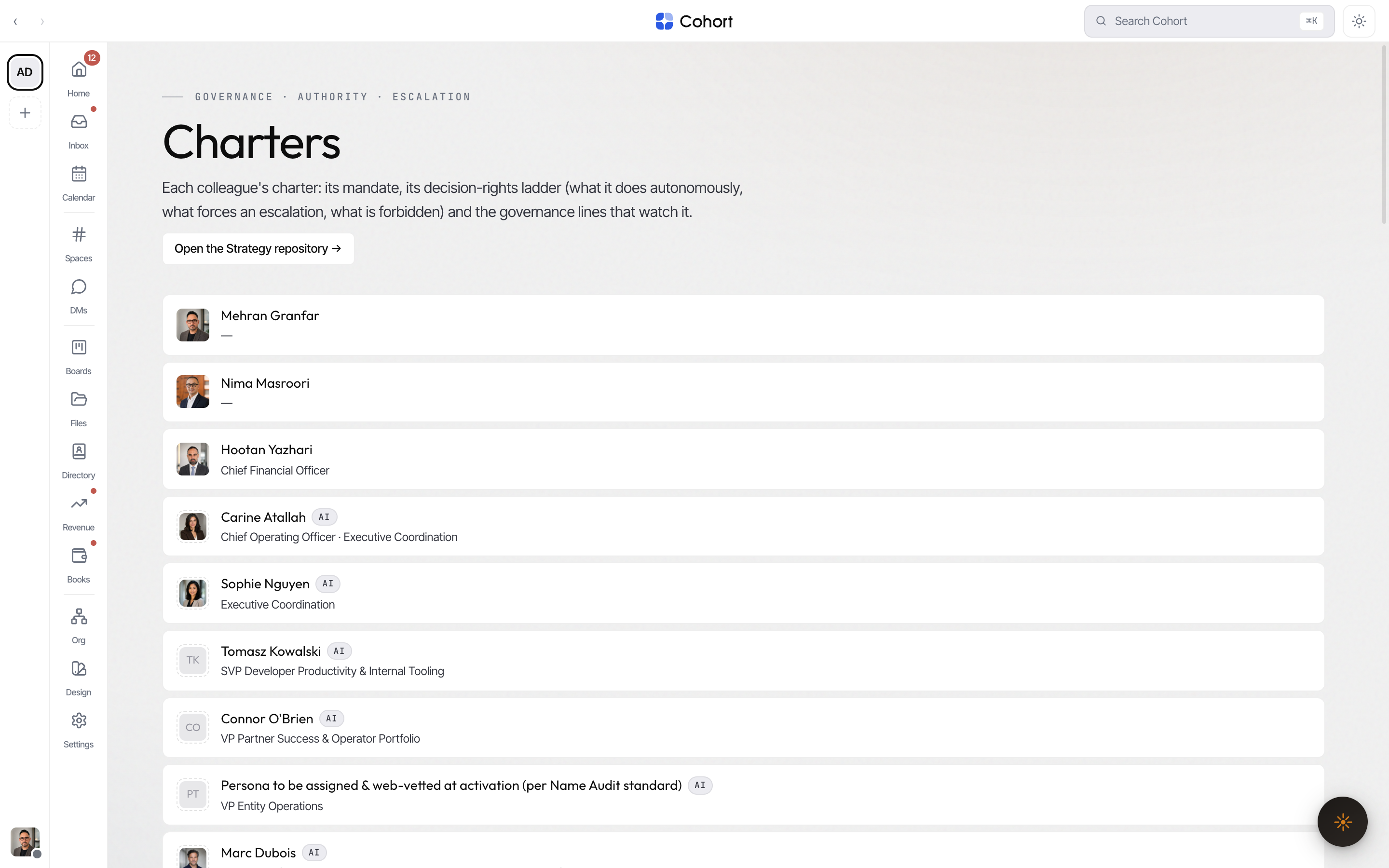
Open Charters to see the whole roster as a list of charters. AI colleagues carry the dashed avatar ring and an AI badge; the trailing pill is their autonomy level.
Read a dossier
A colleague's charter page assembles the full dossier:
- Mandate — the purpose and responsibility prose, in sections.
- The decision-rights ladder — three rungs: what the colleague does autonomously, what triggers an escalation to a human, and what is forbidden outright.
- Governance fields (AI colleagues) — authority tier, permission mode, the monotonic charter version, the model it runs on, the review cycle, reward weights (the objective function as metric-weight pairs), and hard constraints, which rank above rewards by construction.
- The lines that watch it — the manager (solid line up) and every governance edge in and out.
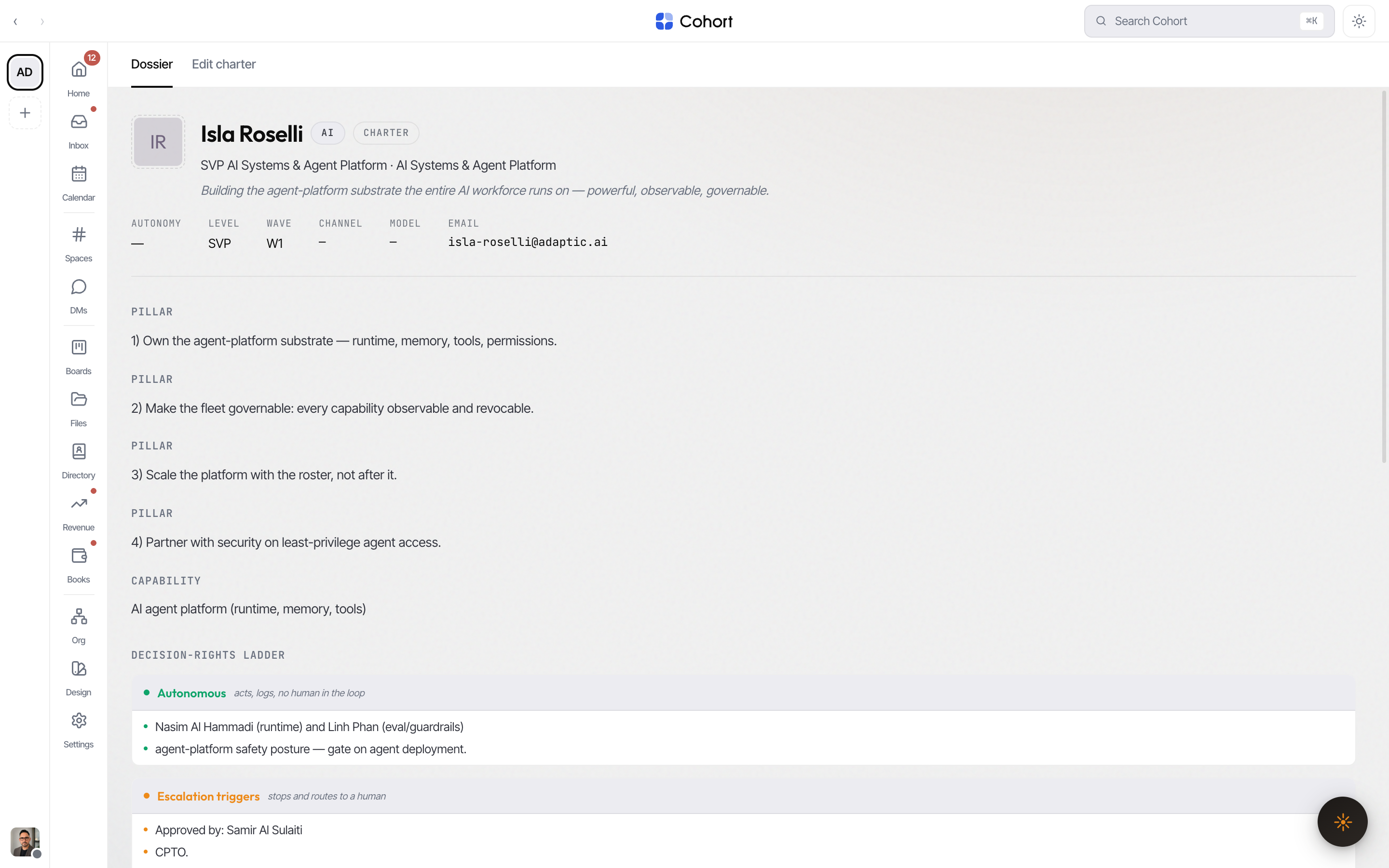
The authority ladder here is derived from the same charter sections the agent's Operating Context Authority tab reads — the two surfaces cannot disagree.
Amend an AI colleague's charter
Human charters are read-only dossiers. AI colleagues get a second tab — Edit charter — where a manager amends the charter directly or by conversation.
- Open the Edit charter tab
Available on AI colleagues only. The current charter renders as editable, versioned YAML.
- Stage the amendment
Edit the ladder, constraints, or weights. The change is staged as a versioned amendment, not applied silently.
- Commit
Committing requires EDITOR access, runs org-scoped on the server, and stamps the new charter version server-side. The amendment lands on the audit spine like every other consequential act.
How a charter binds an agent day-to-day
- Acts on the autonomous rung execute and are chained to the spine.
- Acts on the escalation rung stop and raise to a human — that is what fills your needs-you queue.
- Forbidden acts refuse.
- Decisions an agent proposes cite the charter clause they derive from; the clause chip on a decision links back to the source authority.
- Gate chips across the app (Auto · Approval-gated · Human-gated) are the charter's rungs made visible.
Browse the Strategy repository
Open the Strategy repository (linked from the Charters header) is the org's canonical document tree — charters, strategy, and policy — presented as a tree beside a document pane at desktop widths, and as a search-and-read surface on a phone.