Org memory: the Cortex
The Cortex is the workspace's operating truth — doctrine, strategy, authority, guardrails, playbooks and knowledge — kept as one searchable index. It is a projection, not a second store: each entry resolves to its live source (a policy, a charter section, a strategy stream, a ledger event) with its version and provenance, so the index can cite but never drift.
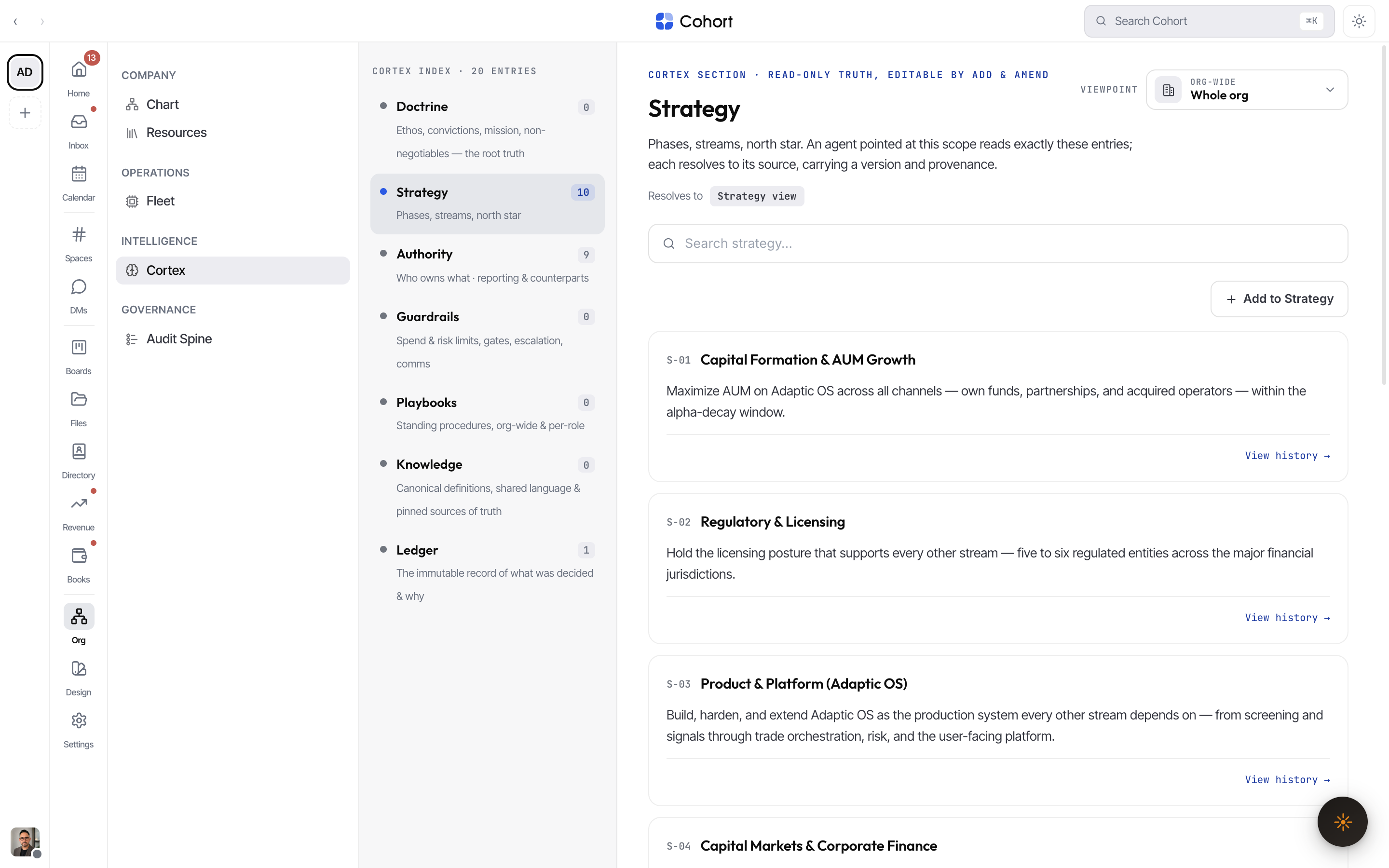
The seven sections
The left rail lists seven sections — Doctrine, Strategy, Authority, Guardrails, Playbooks, Knowledge, Ledger — each projecting one or more of the nine underlying memory classes (framework, constitution, strategy, policy, org graph, SOPs, glossary, sources, ledger). Pick a section to see its entries as cards: title, summary, version, scopes, and who last touched it, human or AI. The Knowledge section also surfaces Sources — the files and references entries derive from.
Each section has its own search box; matching filters the cards live. Open a card for the detail view: full amend history (v1, v2 … with author and note per revision) and the pointer to the live source it resolves to.
Add to a section
- Choose the section and select Add
A multi-class section files your entry into its canonical class.
- Title, summary, scopes
Scopes narrow who and what the entry applies to; leave them empty for org-wide truth.
- Save
The entry is written with your provenance and a spine event — versioned from v1.
Amend an entry
Amending opens the same composer over the existing entry. An amendment requires a revision note — the change must be auditable — and bumps the version, with the previous state kept in the entry's history.
Proposals: agents suggest, you merge
Agents do not amend the Cortex directly. An agent that wants to change an entry proposes an amendment; the proposal waits on the entry, marked pending, with the proposer and their note. Accept & merge versions the entry with the proposal's content — the role check and the no-self-merge rule are enforced server-side, and a refused merge states its reason inline. A proposal you do not merge stays pending on the entry.
The Cortex indexes what the org has authored: frameworks, policies, SOPs, glossary terms, strategy, the org graph and the decision ledger — plus entries you and agents add here. Day-to-day traffic (mail, messages, calls) is not Cortex material; it feeds agent memory below.
How agents recall
Alongside the Cortex, the workspace keeps a unified agent memory over its actual activity — interactions, actions, and consolidated digests of channels, calls and work. When an agent — or Coh, the assistant you can call up anywhere in the product — needs context, recall runs server-side:
- Scoped — to the whole org, the agent's own perspective, one channel, or one entity; a channel scope matches the channel's digest and the threads, tasks and ended calls inside it.
- Layered — broad questions surface consolidated summaries first; specific ones surface the raw items, each with drill-down pointers to what it was derived from.
- Access-floored — every result is filtered by the same visibility rules you hold: restricted channels and named-only records stay absent from an agent's recall exactly as they are absent from its lists. Cortex entries are re-verified against the live entry at recall time, so a narrowed or archived entry stops surfacing immediately.
There is nothing to configure here — recall is how grounded answers across the workspace (ask-the-sheet, ask-the-pipeline, agent briefs) find their context.