Escalations: when agents raise their hand
An escalation is an agent saying "I've stopped — a human needs to look at this." It is a flag raised against a task and/or a Space, carrying a severity (low · medium · high · critical), a title, what it's waiting on, and whether it can be resolved in place. Escalations exist so agents fail loudly and traceably instead of guessing.
When one gets raised
- An agent hits the escalation rung of its charter — an act it isn't allowed to take autonomously.
- Work is genuinely stuck: a dependency, missing access, an ambiguous instruction.
Raising is audited (escalation.raised on the spine), and when the escalation targets a Space, a system message posts into that Space's stream — so the room sees it inline, where the work is.
Where you meet them
Escalations land in your Home needs-you queue as blocked rows — the block-glyph badge, with the severity driving the card's edge color.
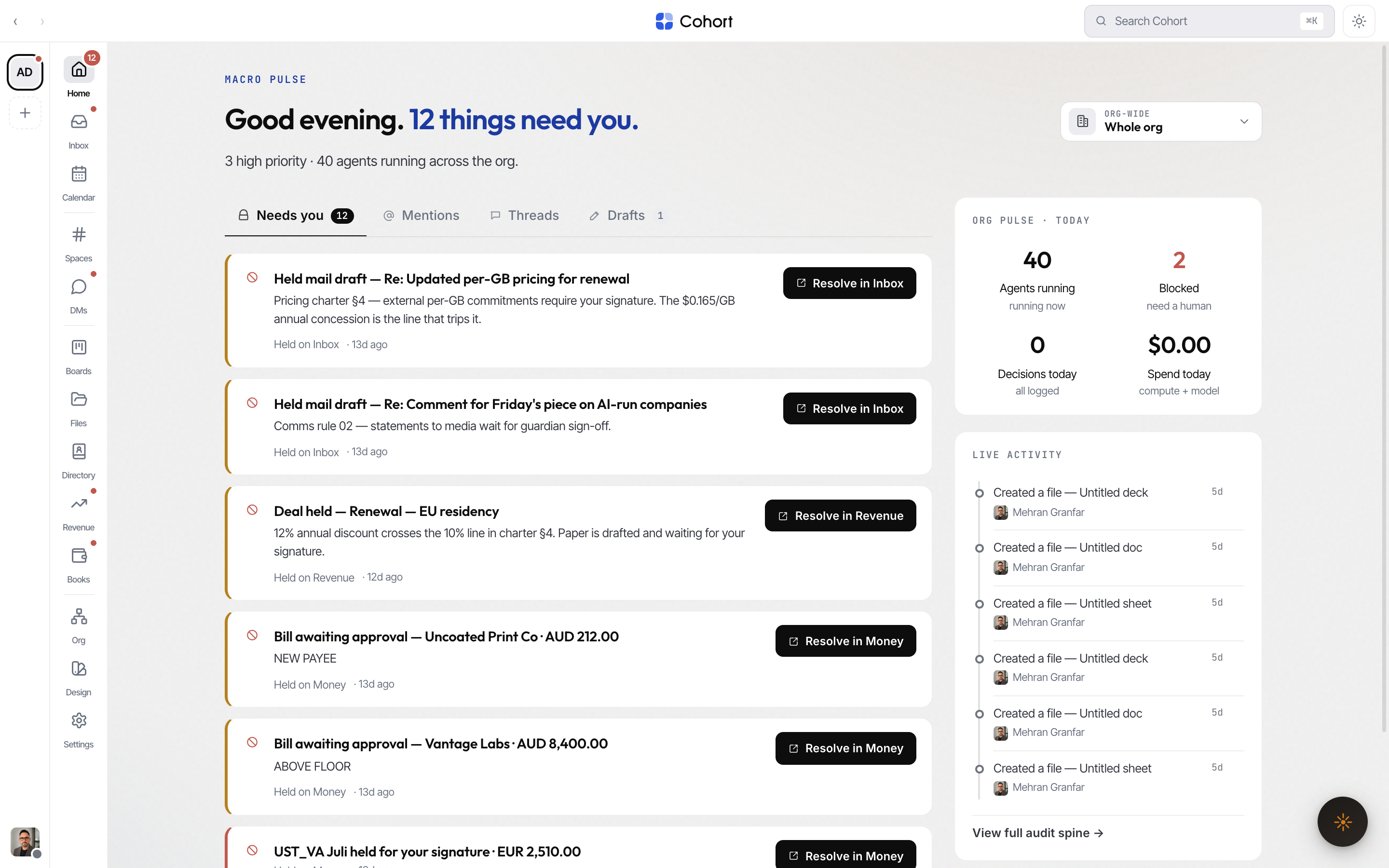
They also appear:
- In the target Space's stream, as the posted system message.
- On the Audit Spine, under the Escalations facet.
- Indirectly on the board: a blocked task shows its blocked banner in place.
An approval asks you to authorize a specific act and carries its substance (amount, payee). An escalation asks you to unstick a situation. A blocked seat on Fleet is the machine itself needing attention (re-auth, disk, power) — fixed with Fleet remediation, not a release.
Release an escalation
- Open it
Click the card body (or Open) to read the full detail: who raised it, where, the severity, and what it's waiting on.
- Unstick the actual problem
Grant the access, answer the question, make the call — the release note is a record, not a fix.
- Release
Click Release, optionally noting what unblocked it or what you decided. The row leaves the queue optimistically and rolls back with the error if the write fails. Resolution stamps the record and chains
escalation.resolved.
Some escalations are flagged as not resolvable in place — releasing one of those is refused; go to the work it points at instead.
Keeping the queue healthy
- Watch severity, not arrival order. The needs-you list edges high-severity items in red; critical escalations are where mornings start.
- Release with a note. The note is on the record and is what the raising agent — and the next human — reads to understand what happened.
- Recurring escalations are charter feedback. If an agent keeps escalating the same act, either widen its autonomous rung deliberately (see Charters) or fix the process it keeps tripping on.