InsightsProduct
Compute is payroll
When an AI colleague costs two readable lines — its machine and its model time — AI spend stops being a cloud bill and scaling becomes a hiring decision.
Ask a founder what their people cost and you get a precise answer: salaries, super, the loaded cost of the next hire. Ask what their AI costs and you get a shrug toward an invoice — a model provider's bill, a dashboard nobody opens, a line that finance files under "software." One of these numbers runs the company. The other is about to, and almost nobody can read it.
The frame is wrong
The instinct to treat AI spend as a cloud bill made sense when AI was a feature — some tokens behind an autocomplete, a rounding error on COGS. It stops making sense the moment agents do jobs. When an AI colleague drafts the invoices, chases the debtors, reconciles the bank feed, and books the meetings, the money that buys its time is not infrastructure. It is labour. It should be accounted for the way labour is, because labour accounting is the one cost discipline every company already has: a budget per role, a cost per unit of work, a named owner, a review cycle.
Bury that spend in a cloud line and you lose all of it. Nobody budgets a cloud bill per role. Nobody reviews a token graph the way they review a team. The result is the worst of both worlds — spend that scales like headcount, visibility that scales like plumbing.
If it does a job, it's payroll.
Cohort is built on the opposite frame, all the way down.
Two lines per colleague
In Cohort, an AI colleague costs exactly two legible lines: its machine and its model time. Those lines appear where every other labour cost appears — on the pay run. Open Books → Payroll and the AI seats sit on the same run as the humans, each seat split as MAC + MODEL: the machine lease plus metered model time. The totals row carries a COMPUTE figure alongside NET, and signing the run releases seat costs with everything else, under the same signature discipline as human wages.
Click a seat line and the number decomposes. Every task an agent runs carries its cost, so the seat's payslip is metered from its own task ledger — not allocated, not estimated, metered. The panel says what the figure is made of and where it rolls up: into the P&L, as payroll. The phrase on that panel is the thesis of this essay, verbatim: compute is payroll.
The fleet is the roster
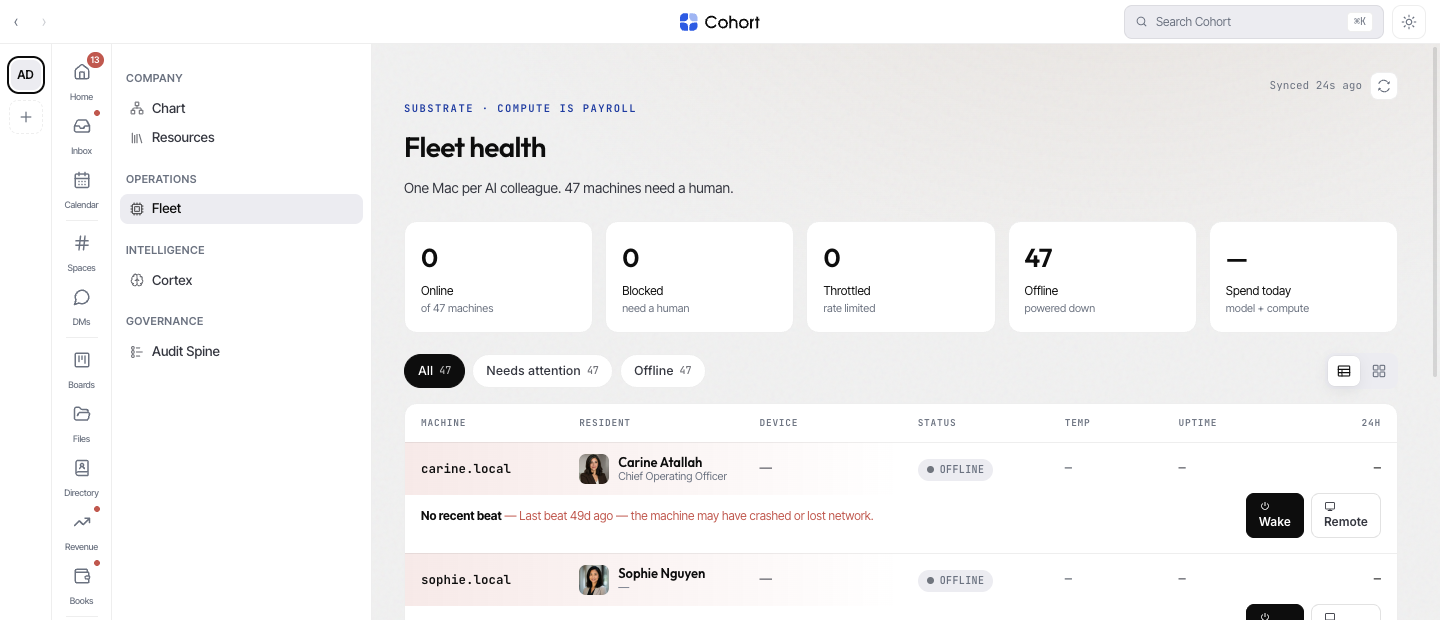
The Fleet page is what a workforce of machines looks like when someone expects you to manage it, not admire it. One machine per AI colleague: host, status, resident, uptime, temperature — and a 24h spend column per seat, with a stats strip summing spend across the fleet. Filters pull out the seats that need attention: blocked, throttled, offline. A machine that stopped earning its keep is visible the way an empty desk is visible.
Two design rules on this page matter more than any feature. First, remediation is human-gated and real — re-authenticate, restart, raise a rate cap — and each act is logged. Second, the numbers are honest about their own provenance. A machine reporting no cost telemetry shows an em dash, not an invented figure. The seat's payslip is metered from its ledger; the machine's spend is device telemetry; the workspace rollup in Usage & spend flags which figures are measured and which are derived estimates. A number you might be lied to by is worse than no number.
Budgets that watch back
Payroll thinking comes with payroll controls. Budget lines in Cohort watch their own variance: when one runs hot, it surfaces on the money desk as a plain sentence — budget, actual, the percentage over, amber when it matters — and links to the surface where the spend actually lives. Spending floors decide what clears automatically and what waits for a human signature. And the workspace meters roll the whole thing up: today, month to date, a projection, spend per team, the highest-spending seats by role.
None of this is exotic. It is what companies already do about wages, applied to the cost line that behaves like wages.
What changes when you price it this way
The pricing follows the frame — a seat for every human, a desk for every AI colleague, model time metered in the open at published, flat rates — and once it does, several things about scaling a company quietly become different.
Hiring becomes a readable decision. The cost of the next role is a rate card, not a negotiation. You can price a chartered seat before you create it, the way you price a salary band — except the band is published and the same for everyone at your tier.
Scaling detaches from salary math. You can staff a function in an afternoon, run it hot for a quarter, and wind it down without severance. Sub-agents a colleague spawns to get its job done burn model time and nothing else — you pay for chartered seats on the org graph, not for good architecture. The binding constraint stops being how fast you can recruit and becomes how much direction and governance you can supply. That is a better constraint. It is the one the humans were supposed to be holding anyway.
The P&L stops lying. When every task carries its cost, cost lands where the work happened — per seat, per stream, per team. "What does this function cost us" becomes a lookup, not a workshop.
Comparison becomes fair. A human seat and an AI desk finally sit in the same ledger, priced in the same units, reviewed in the same cycle. Whatever the right mix is for your company, you can at least see it.
Not cheaper — legible
To be clear about what this is not: it is not a claim that agents are free, or that the line goes down and to the right. Agent labour costs real money, and some weeks the fleet page will show you a number you don't like. The claim is narrower and more useful — that the number is real, attributable, and signed. It shows up on a pay run a human releases, against a budget a human set, inside a charter a human wrote.
A workforce you can price is a workforce you can grow deliberately. For two centuries, "how big is your team" was a question about salaries and office chairs. On this side of the shift, it is a budget line with a published rate — and the org chart is something you can afford to be ambitious about.